THE CREAM CITY FLÂNEUR
A Guide to Noticing
A queer memoir of Milwaukee, its missing places, and the man who grew up among them.
The Pitch
What if the most revealing history of a city isn’t found in its archives, but in the memories of the people who lived, loved, fucked, failed, and started over in its buildings?
The Cream City Flâneur is an unconventional literary memoir disguised as a walking guide to Milwaukee, Wisconsin.
Part urban history, part queer autobiography, part architectural obsession, and part personal excavation, the book follows one gay man wandering through the city that shaped his adult life, discovering that the buildings, streets, parks, and neighborhoods he thought he knew contain the scattered evidence of twenty-five years of becoming himself.
It begins with an ordinary September evening.
Bored and restless, recently divorced, and reconsidering nearly every assumption he’d made about his life, the narrator leaves his apartment for a walk.
He discovers that entire blocks of his neighborhood were demolished decades earlier for a freeway that never materialized.
What begins as a curiosity about Milwaukee’s abandoned highway plans becomes an excavation of his own history.
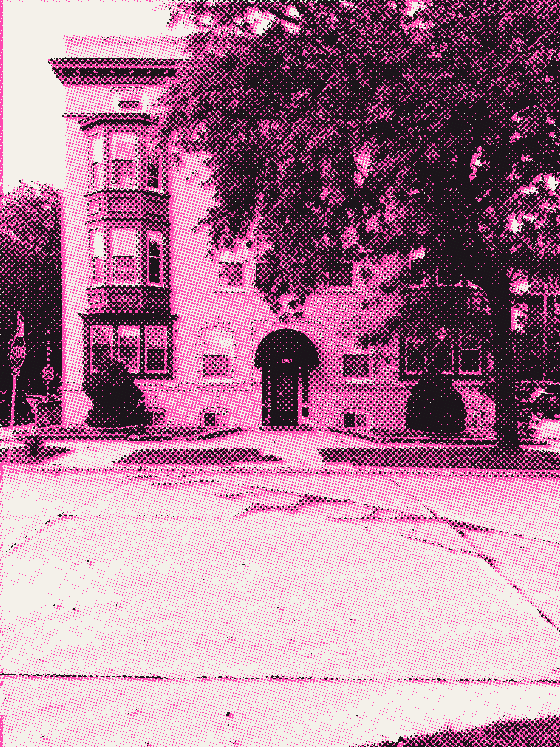
An apartment he occupied twenty years earlier turns out to be an architecturally significant building. A former art school was demolished for a road that never arrived. A grand residential hotel recalls an entirely different way of organizing a life.
And the city’s official history begins colliding with another, considerably less respectable record.
Frank about sex · Tap to read
A blowjob in the shadow of a church.
A handjob in Juneau Park.
A marriage that lasted fifteen years.
A divorce that ruptured nearly everything he thought he understood about himself.
The collapse of a corporate career. The reconstruction of a family, a business, and an identity. A growing realization that belonging somewhere and merely being present there are two very different things.
Milwaukee becomes both setting and subject, its physical transformations running alongside the narrator’s own.
But this is not a story about a broken man rebuilding himself, or a wounded city healing its scars.
It’s about learning to recognize what’s been there all along.
The Book
For more than twenty-five years, the narrator has lived inside Milwaukee’s changing landscape.
He arrived in 2000, as the city was beginning to reconsider the urban-planning decisions that had reshaped it during the twentieth century.
He lived in aging East Side apartment buildings, watched freeways disappear, saw neighborhoods redevelop, worked in downtown office towers, participated in Milwaukee’s LGBTQ community, married, divorced, and eventually began questioning whether the city he had called home for most of his adult life still fit the person he was becoming.
Throughout those years, he accumulated an enormous personal archive.
Apartments. Photographs. Conversations. Digital journals. Relationships. Sexual encounters. Old emails. Neighborhood memories. Forgotten places.
The archive is messy, incomplete, sometimes contradictory, and occasionally embarrassing.
That’s precisely the point.
The Cream City Flâneur treats lived experience as a form of historical evidence, placing private memory alongside architectural records, city plans, newspaper archives, and neighborhood histories.
The narrator is neither a detached historian nor a conventional travel writer.
He is a participant in the history he’s investigating.
He doesn’t always remember things correctly. He sometimes discovers that a building he thought was old is relatively new, or that a neighborhood he remembers fondly was itself the product of earlier destruction.
And sometimes the historical research gets interrupted by an entirely unrelated memory about sex.
Because that’s how memory actually works.
Why This Book
Cities preserve what they consider significant.
They designate historic districts, protect architecturally important buildings, erect monuments, and publish histories of influential people.
But the personal histories that give those places meaning are far more difficult to preserve.
Queer histories are particularly vulnerable.
For generations, much of LGBTQ life happened outside officially recognized institutions, in bars, parks, apartments, public spaces, and informal social networks.
Those places may disappear without ever receiving a plaque.
The people who remember them grow older. Their photographs get lost. Their digital lives become inaccessible. Their stories go untold.
The Cream City Flâneur asks what happens when one person decides that the unrecorded parts of his life deserve preservation too.
Not because he’s historically important.
Because he was there.
And because the history of a city belongs to more than the people whose names appear on its buildings.
The Narrative Approach
The book unfolds through a series of walks, each beginning with a real place and following the associations it produces.
A demolished freeway corridor leads to memories of an old apartment.
A church opens a conversation about religion, sexuality, and the private geography of queer life.
A residential hotel raises questions about domesticity, marriage, and the different ways people organize their relationships.
A former office building recalls the years spent making himself acceptable inside corporate culture.
A neighborhood undergoing redevelopment becomes an occasion to reconsider who gets to define belonging.
The narrative moves freely between the present walk, documented history, and personal memory.
It embraces digression.
It allows uncertainty.
It doesn’t insist that every observation become a lesson.
Some passages are funny. Others are uncomfortable. Some are explicitly sexual. Some are simply enthusiastic descriptions of buildings that most people would walk past without a second thought.
The voice is candid, curious, irreverent, and occasionally profane.
This is a memoir that refuses to become respectable merely because it has learned how to research its footnotes.
Proposed Structure
- Forced Perspective: Milwaukee’s Scars
The opening walk through Yankee Hill, East Pointe, Burns Commons, and Juneau Park. The abandoned Park East Freeway becomes an entry point into the narrator’s own history and the realization that he’s spent decades living among things he never fully understood.
Read it now: Forced Perspective - Humboldt, Lyon, and the Architecture of Home
The apartments, neighborhoods, and domestic spaces that shaped the narrator’s early adulthood. A history of Milwaukee housing becomes a personal history of independence, friendship, desire, and the gradual construction of an adult identity.
- Queerdo in Cream City
A personal geography of Milwaukee’s queer life, including its bars, parks, cruising spaces, apartments, friendships, and sexual encounters. An examination of the history that survives in memory even when its physical landmarks disappear.
- After Love Is Love
Marriage equality, fifteen years of marriage, divorce, and the complicated freedom of reconsidering intimacy outside conventional relationship structures. A personal story situated within the broader history of LGBTQ rights and changing ideas about love.
- Adaptive Reuse
Work, identity, family, estrangement, career change, and the reconstruction of a life after the institutions that once defined it stop making sense. Milwaukee’s reused buildings become a recurring setting, though not a tidy metaphor, for a period of personal transformation.
- Presence Without Belonging
The narrator considers leaving Milwaukee after twenty-five years. The final walks revisit places that once defined home and ask whether belonging requires staying, leaving, or simply learning to inhabit a place differently.
Beyond the Book
The Cream City Flâneur is conceived as both a literary work and a living archive.
Individual essays will first appear through Boiling Point Identity Press, accompanied by researched walking guides, photographs, historical references, and maps.
These pieces will form the foundation of a larger book, allowing readers to explore the geography while the long-form narrative develops.
The project also establishes a framework for preserving personal histories that might otherwise disappear into abandoned digital accounts, forgotten photographs, and private memories.
Rather than presenting the finished book as the definitive history of Milwaukee, it invites readers to reconsider their own relationships with the places they inhabit.
What do we remember?
What do we overlook?
And who decides which parts of our lives are worth recording?
About the Author
Aaron Berth is a Milwaukee-based writer, creative consultant, and founder of Dopamine Furnace Creative and Boiling Point Identity Press.
After more than twenty-five years living and working in Milwaukee, he began documenting the intersections of urban history, queer identity, personal memory, and the changing meaning of home.
His work draws on lived experience, architectural curiosity, extensive personal archives, and a longstanding fascination with the places people occupy and the identities they construct within them.
The Cream City Flâneur is his first proposed book-length literary project.
Milwaukee built me.
Not all at once, and certainly not according to plan.
It happened in old apartments with ridiculous floor plans, in office towers, in bars, in parks, in churches and their shadows, in relationships that lasted years and encounters that lasted considerably less.
It happened in a city that kept tearing things down and putting other things in their place.
For twenty-five years, I’ve been walking through the evidence.
Now I’m finally paying attention.
This is an unrespectable respect to the city that built me.
Brick by Cream City brick.